






Limitorque Network Controls
Limitorque supports seamless integration with plant control systems by providing a range of open-architecture digital network protocols and control options. These connected actuators deliver dependable long-term monitoring and management of valve systems.
DeviceNet™
DeviceNet™ uses CAN (Controller Area Network) for its data link layer and CIP™ (Common Industrial Protocol) for the upperlayers of the network. DeviceNet supports multiple communication hierarchies and message prioritization, and can be configured to operate in a master-slave or a distributed control architecture using peer-to-peer communication to perform actuator process control and feedback data retrieval. The ODVA (Open DeviceNet Vendor Association) registered Limitorque Electronic Data Sheet (EDS) description file is used to configure the actuator parameters for supreme control system performance.
Network Controls - DeviceNet™
Features and Benefits
- DeviceNet Group 2 Server implementation
- Broad application flexibility via support for multiple communication hierarchies and message prioritization
- Standard polled I/O connection, standard bit strobed I/O connection, standard change of state/cyclic I/O connection offered
- Bus powered network
- Greater reliability and reduced downtime assured by cyclic redundancy checking (CRC), auto retries, and bus-powered network interface that allows alarm information to be communicated when actuator loses main power
- Complies with EMC requirements to European Directive 2004/108/EC and vibration/seismic requirements to Machinery Directive 2006/42/EC
Specifications
DeviceNet complies with the CAN Based protocol (Controller Area Network)
Configurations
Network Protocol
DeviceNet utilizes the Common Industrial Protocol (CIN) over a Controller Area Network (CAN) defining an application layer which covers a number of actuators
Network Service
Can be fitted to either MX or QX
Related Literature
Technical Information
Software Downloads
Foundation Fieldbus H1 with DTM
Limitorque actuators with Foundation Fieldbus can act as a link active scheduler and time master for regulating communication on a fieldbus segment. The Fieldbus Foundation has tested and registered the Limitorque Device Description (DD) files to ensure interoperability with registered devices from multiple vendors. In addition, The FDT Group has certified the DTM (Device Type Manager) for use with both standalone and non-standalone frames.

Network Controls - Foundation Fieldbus H1 with DTM
Features and Benefits
- Includes Link Active Scheduler (LAS) that controls system
- Offers high speed communication up to 31.25 kbits/sec
- Broad network versatility from support for multiple topologies, including point-to-point, bus with spurs, daisy chain, tree or combinations of these
- Ease of installation and setup with direct connection to PLC or DCS systems from major manufacturers, including Emerson, Honeywell, ABB and Yokogawa
- Increased performance, safety and environmental compliance from Flowserve ValveSight support
- Complies with EMC requirements to European Directive 2004/108/EC and vibration/seismic requirements to Machinery Directive 2006/42/EC
Specifications
Foundation Fieldbus standard IEC 61158-2 Fieldbus H1
Configurations
LAS (Link Active Scheduler)
Permits a single field unit to act as bus arbiter which can add or remove units from the link, schedule control activity in, and communication activity between, devices, and distribute priority-driven token for unscheduled transmissions.
Related Literature
Technical Information
Software Downloads
HART with DTM
HART® (Highway Addressable Remote Transducer) is a digital communication protocol that is based upon the Bell 202 telephone communication standard. By using FSK (frequency shift keying) to superimpose low level digital signals on top of an analog 4-20 mA signal, two simultaneous communications channels exist. The 4-20 mA signal communicates the primary measured value, and the digital signal communicates additional device information to the plant control system.
Network Controls - HART with DTM
Features and Benefits
- Digital signal on conventional 4-20m ADC analog signal
- 1200 bps binary phase - continuous frequency-shift-keying
- Distances up to 1800 meters/network (up to 15 devices)
- EDDL (IEC 61804-2, EDDL) with methods for all supported Common Practice & Device Specific Commands
Specifications
Complies with HART Protocol Specification document HCF_SPEC-13 for rev. 7.3
Configurations
Network Protocol
HART (Highway Addressable Remote Transducer) was developed by Emerson for the purpose of communicating a digital signal over analog (4-20 mA) input. It is perhaps the most widely used type of digital protocol.
Network Service
Can be fitted to either MX or QX
Related Literature
Technical Information
Software Downloads
Limitorque® Master Station IV
The Flowserve Limitorque® Master Station IV is a Modbus master station designed to interface between the field unit (actuator) and a user's DCS or PLC. It can help minimize integration efforts and save users time and money during startup and commissioning while helping maintain asset integrity. It can be used in all global industrial markets.
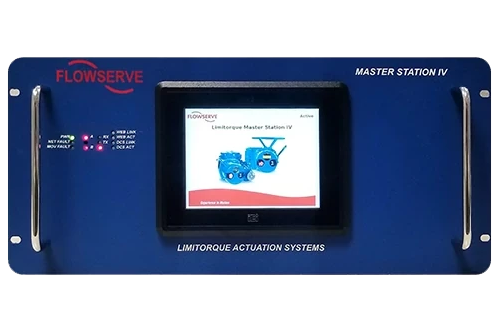
Network Controls - Limitorque® Master Station IV
Features and Benefits
- Supports priority polling
- Configuration of slave register polling schedule
- Data/event logging
- Network control up to 250 devices
- Modules can operate independently or be externally coupled to provide redundant communications
- Industry standard Modbus RTU, ASCII or TCP/IP protocols
- Secure access utilizing up to three levels of user password protection
- 6.5 in IP65 industrial touch-screen monitor (optional)
Specifications
NEMA 4/4X
CE
Complies with Modbus standards for integration and register mapping
0°C to 50°C (32°F to 122°F)
Size range: Single and hot-standby configurations
Modbus
Modbus is a data communications protocol originally published by Modicon in 1979 as a means of communicating with PLCs. Limitorque Smart actuators can have the option to communicate over this protocol by means of Serial or Ethernet options. Limitorque smart actuators equipt with the modbus option can also be paired with the Limitorque Master Station for greater control and feedback of the loop.

Network Controls - Modbus
Features and Benefits
- Ability to monitor and control up to 250 actuators on a single loop.
- Perform ESD and PST functions.
- Serial Modbus is redundant.
- Built in repeater and terminators.
- Serial Modbus baud up to 38.4k.
- Serial Modbus isolated, surge protected port
- Ethernet Modbus 10/100 baseT.
- Ethernet Modbus built in web server.
- Limitorque Advanced Diagnostics to poll graphs/logs/status.
Configurations
- Modbus RTU
- Modbus ASCII
- Modbus TCP/IP
Technical Information
Profibus DP Redcom
Compatible with Limitorque non-intrusive MX multi-turn and QX quarter-turn actuators, the Profibus DP with Redcom network protocol complies with the Profibus specification 2.212_V and allows connection with a single or dual redundant channel networks (optional). The new and improved DTM (Device Type Manager) greatly reduces the time required for configuring and acquiring pertinent diagnostic information.
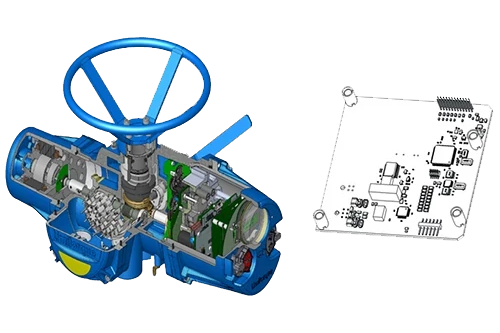
Network Controls - Profibus DP Redcom
Features and Benefits
- Significant reduction of redundant channel switchover times from 12-13 seconds to 500 ms
- Increased safety and product integrity through double-sealed protection that isolates the controls compartment from corrosive or severe environments
- Absolute encoders with built-in self-test (BIST) capability that switches to redundant circuits in the event of a single sided failure, allowing actuator to continue operation while highlighting the need for inspection
- Optional 4th conduit for both MX and QX providing the user with dual conduits for network redundancy – one for ingress and one for egress
Specifications
Complies with Profibus International specifications, Slave-Redundancy_2.212_v12_Nov04, and transfers communication in ≤ 500 ms per specification. Also supports NAMUR NE-107 (NAMUR, international user association of automation technology in process industries) and (NE-107, recommendation for standardized status signals in the process industries).
Related Literature
Technical Information
Software Downloads
Profibus PA
PROFIBUS PA is used to monitor and control equipment in process automation applications. PROFIBUS PA uses the same protocol as PROFIBUS DP, and can be linked to a PROFIBUS DP network using a coupler device.

Network Controls - Profibus PA
Features and Benefits
- High speed communication up to 31.25 kbits/sec
- Broad application flexibility via analog and digital input/output function blocks
- Ease of installation and setup made possible by direct connection to PLC or DCS systems from major manufacturers, including Emerson, Honeywell, ABB and Yokogawa
- Device descriptors
- Bus powered for 9-32 VDC and 15 mA per actuator
- Increased performance, safety and environmental compliance from Flowserve ValveSight support
- Complies with EMC requirements to European Directive 2004/108/EC and vibration/seismic requirements to Machinery Directive 2006/42/EC
Specifications
Profibus PA to EN 50170 Fieldbus standard and Fieldbus physical layer per IEC-61158-2 for communication.
Configurations
Network Protocol
Profibus PA (Process Automation) used to monitor measuring equipment in process control automation
Network Service
Can be fitted to either MX or QX.
Related Literature
Technical Information
Software Downloads

Limitorque Actuators and Instrumentation
Discover Limitorque’s legacy of innovation in actuator technology, trusted for decades to deliver reliable flow control solutions worldwide. Learn how their advanced electric and fluid power actuators enhance automation, efficiency, and safety across industries.